
As a Native-owned IHS staffing company, Ellsworth was built to solve a crisis the standard healthcare recruitment industry has never been equipped to address. In 2025, we closed the year with 11 new purchase orders covering 15 candidates, and across both new and existing agreements, we successfully placed 35 different candidates across 64 assignments. Our total awarded amount now stands at $10.1 million across 77 transactions, and our most recent CPARS reviews reflect “Very Good” in Management and “Exceptionally Met” in Quality. View our full company profile on G2Xchange and USASpending.gov.
I named my company after my grandfather on my dad’s side. Ellsworth is also my middle name. I didn’t love it when I was growing up, but much like the company that bears his name, it has grown on me and gained authority.
My dad’s dad served as a medic in World War II and survived the Battle of the Bulge. On my mother’s side, my grandfather Jesse Bizardie Sr. was a Navajo Code Talker. He helped win that same war by speaking a language the enemy couldn’t break.
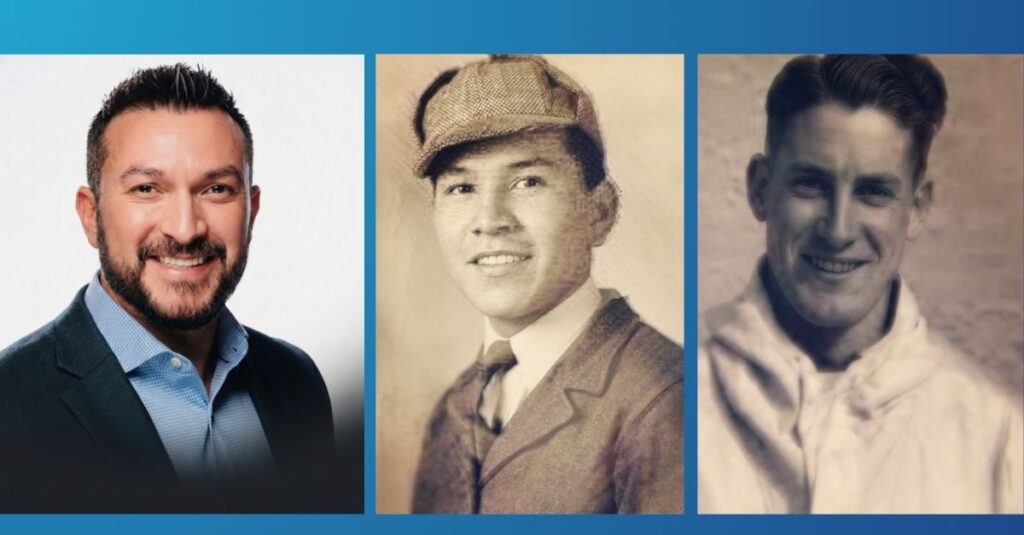
Two grandfathers. Two wars. Two forms of service — and one company built to honor both. Their legacies shape every placement decision we make.
My grandfather Ellsworth later became a philosophy professor specializing in children and young adults. He knew that healing people requires showing up for them, no matter their age, under impossible conditions, with whatever you have.
The Crisis That Brought Ellsworth to Indian Country
There is a number that sticks with me: 2,500. There are very few Native doctors in Indian Country. For a population of over 9 million Indigenous people in the United States alone, there is roughly one Native physician for every 3,600 Native patients. While about 70% of us live away from our tribal lands and rely on employer insurance, that ratio is still drastic.
So why is that?
For one, I don’t think this is an ambition problem. Many of us dream of going to the moon, being a firefighter, a police officer, or a teacher, but far fewer dream of being a doctor. But we are here now. The question is not how we got here — it is what we are going to do about it.
Why Native-Owned IHS Staffing Companies See a Different Crisis
Federal data reports a 35% staffing vacancy rate at Indian Health Service (IHS) facilities. The number our company sees on the ground is closer to 70%. That gap is not a rounding error — it is the difference between a child in Shiprock, New Mexico, getting a pediatric nurse and going without one. It is the reality of waiting three months just to onboard a single physician.
These understated numbers matter because policy follows data. When Washington looks at a 35% vacancy rate, the urgency feels manageable. When the real number is double that, you have a crisis that demands systemic change, not incremental budget adjustments.
Perhaps our cultural understanding — our Native Ways of Knowing — creates friction with the traditional medical path. There are cultural taboos, extended time required away from home, and a lack of Native peers to lean on. When Native students do make it into medical school against all odds, they often find institutions with no cultural framework for who they are or where they come from.
As a result, dropout compounds at every stage of joining the medical field. We lose people not because they lack ability, but because nobody built this system for us.
Cultural Competency Is What Separates Native-Owned IHS Staffing from the Rest
When I started Ellsworth, I kept hearing the same challenges from IHS facility directors: providers would arrive, last a few months, and leave. Ghosting. Burnout. Mismatch. The patients felt it. The staff felt it. And the facilities were right back where they started, posting the exact same positions.
The standard staffing industry answer is to recruit harder and onboard faster. That misses the diagnosis entirely. A provider who has never lived in a rural tribal community, who doesn’t understand extended family structures, or who isn’t prepared for the spiritual dimensions of Indigenous approaches to health and healing is simply not well-matched for the work — no matter how qualified they are.
In fact, cultural competency is not a checkbox in an orientation packet. It is the foundation upon which patient trust is built. In communities where government programs systematically betrayed that trust for generations — through missionary medicine and forced sterilizations — providers must earn it carefully and deliberately.
That is precisely why the long-term solution cannot rely on recruiting outside providers at scale. We must grow Native providers from within. Learn more about how Ellsworth approaches provider placement and the cultural competency standards we hold every candidate to.
Building an Actual Onramp for Native Doctors
Building a Native physician workforce requires intervening at every point where we currently lose people. This means starting at the beginning of the pipeline, not just the end.
Increase Visibility: Native youth need to see Native doctors, nurses, and healthcare administrators. Representation is not symbolic; it is proof of existence. It tells a teenager in Ganado, Arizona, that this path is possible.
Meet Students Geographically: The model of uprooting rural Native students and expecting them to thrive in culturally mismatched universities has a poor track record. Leaving home isn’t always the right fit. We need more vocational and professional training brought directly to the community through online programs, regional campuses, and hybrid models. We are getting there — I am currently finalizing the launch of Ellsworth College, our own online vocational institution designed specifically for this gap.
Provide Institutional Support: We must continue advocating for scholarships and loan forgiveness programs structured specifically for IHS service. But financial aid isn’t enough. Students need mentorship networks, cultural support structures, and clear pathways back to their home communities after training.
Reform Credentialing: The IHS onboarding process is notoriously slow and punishing. Facilities lose candidates to competing offers simply because the paperwork takes too long. Every week a position sits vacant is another week a patient goes without care.
This Is a Solvable Problem
I was born in Tuba City. I grew up in Ganado. I finished high school in Gallup. I know what it looks like when a community’s healthcare is disconnected from the full fabric of reservation life — but I also know what it looks like when it starts to work.
When we lead with what I call the “Four I’s” — Indigeneity, Innovation, Intention, and Impact — we create something a spreadsheet can’t fully capture. Together, we build environments where people want to work, where patients feel seen, and where the next generation of Native healers can easily imagine themselves. That is the standard every Native-owned IHS staffing operation should be measured against.
That 2,500 number is not the ceiling. It is a starting point. But it will only grow if we treat it with the urgency it deserves. This is a public health emergency that demands the exact same energy, investment, and political will we bring to any other crisis in American medicine.
All we do, we do for Our Relatives. It is past time the system did the same.
AUTHOR BIO: Michael Woestehoff is CEO of Ellsworth LLC, a Native-owned IHS staffing company and 100% Navajo-owned enterprise based in Washington, DC. Named for his paternal grandfather — a WWII medic who survived the Battle of the Bulge — Ellsworth also carries the legacy of his maternal grandfather, Navajo Code Talker Jesse Bizardie Sr. Woestehoff is a 2010 NCAIED 40 Under 40 honoree.
Your Career, Our Expertise. Adventure Awaits: Join Ellsworth for rewarding locum tenens and medical staffing opportunities. Expertly Placed: 22 years of combined recruiting expertise at your fingertips. Culturally Competent Staffing: Specialized ISBEE-eligible solutions for healthcare professionals. Your Next Journey Starts Here: Create your free profile and embark on a rewarding career. Sign up now! Create your free profile.